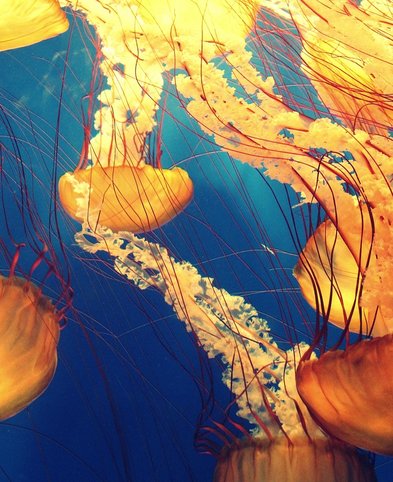


Behind the cloak-like webbing and red eyes is one of the deep ocean's most misunderstood and gentle inhabitants.
Some deep-sea animals don't flash to be seen — they glow to become invisible from below.
Where superheated fluid meets near-freezing seawater, life gathers — and some of it glows.
The chemistry behind living light is surprisingly simple, and it has evolved independently dozens of times.
In a world of blue light, red is the new black — a color that hides rather than warns.
A look inside the chemical machinery that lets deep-sea creatures turn their own bodies into lanterns.
The anglerfish's famous lure is only part of a strange and surprisingly varied hunting strategy.
Between the sunlit surface and the abyss lies the largest habitat on Earth, and it is stranger than either.

At depths where a human body would be destroyed instantly, whole ecosystems thrive without flinching.
The chemistry that lights up the deep sea has quietly become one of the most useful tools in the laboratory.
Behind the cloak-like webbing and red eyes is one of the deep ocean's most misunderstood and gentle inhabitants.
Some deep-sea animals don't flash to be seen — they glow to become invisible from below.


The chemistry behind living light is surprisingly simple, and it has evolved independently dozens of times.
In a world of blue light, red is the new black — a color that hides rather than warns.
Between the sunlit surface and the abyss lies the largest habitat on Earth, and it is stranger than either.
The chemistry that lights up the deep sea has quietly become one of the most useful tools in the laboratory.
Some deep-sea animals don't flash to be seen — they glow to become invisible from below.


The chemistry that lights up the deep sea has quietly become one of the most useful tools in the laboratory.
Read More
Some deep-sea animals don't flash to be seen — they glow to become invisible from below.
Read More
The chemistry behind living light is surprisingly simple, and it has evolved independently dozens of times.
Read More
The chemistry behind living light is surprisingly simple, and it has evolved independently dozens of times.
In a world of blue light, red is the new black — a color that hides rather than warns.
A look inside the chemical machinery that lets deep-sea creatures turn their own bodies into lanterns.